

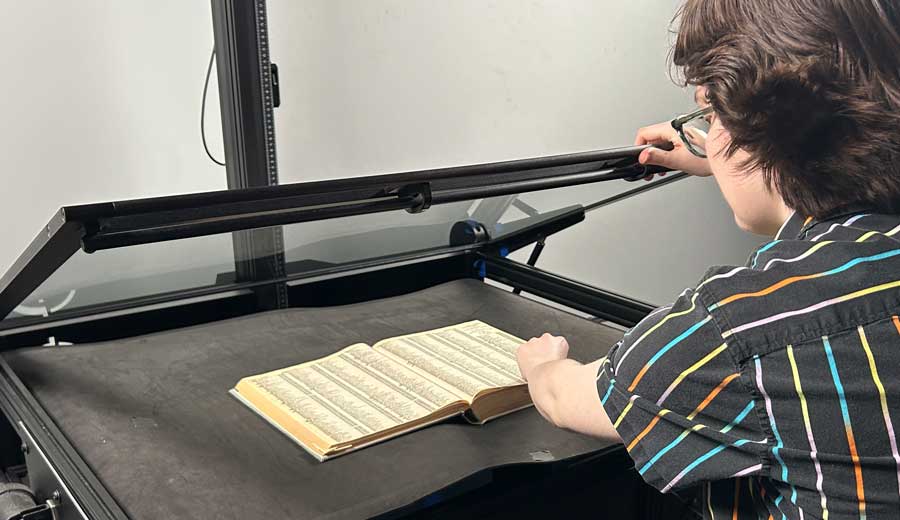
Thousands of pages of historical city directories are being digitized to help families — including those who have moved away — locate the residency records needed to file federal radiation compensation claims before December 31, 2027.

By Managing Partner Farica Chang
ST. LOUIS, MO — With the federal deadline approaching to file claims under the Radiation Exposure Compensation Act (RECA), the St. Louis County Library and Anderson Archival have partnered on a pro bono initiative to preserve and expand access to the historical records many families need to document their connections to contaminated communities.
Anderson Archival is providing the digitization work on a pro bono basis to help expand practical access to records that may be important to families pursuing RECA claims, while reducing handling of the Library’s original directories.
All RECA claims must be filed by December 31, 2027. For the thousands of former St. Louis-area residents who now live elsewhere, assembling proof that they lived, worked, or attended school in a qualifying community is often the hardest part of the process, and the clock is running.
Through the partnership, Anderson Archival is digitizing thousands of pages of historical city directories from the Library’s collections and applying OCR so the documents can be searched more easily by name and address. Directories are among the most useful records for establishing historical residency, because they list residents by name and address year over year. For former St. Louis-area residents and family members who now live elsewhere, that means the records can be located more efficiently without starting the process with an in-person visit to the Library.
Importantly, while digitization helps people find the right record, it does not replace it. The U.S. Department of Justice requires certified or original documents to substantiate a RECA claim. A digital directory page can tell a family exactly which record to request, and where to request it from.
Why the RECA Deadline Matters Now
RECA was reauthorized and substantially expanded on July 4, 2025, under the One Big Beautiful Bill Act (Pub. L. 119-21). That law created a new Manhattan Project waste claimant category, covering St. Louis-area residents for the first time in the program’s history.
Under current law, eligible claimants must have been physically present in one of 21 qualifying Missouri ZIP codes for at least two years after January 1, 1949, and must have been diagnosed with a covered illness. Living claimants receive the greater of $50,000 or their documented out-of-pocket medical expenses; eligible survivors of deceased claimants receive $25,000.
The response has been significant. As of June 25, 2026, more than $100 million had been paid to Missouri claimants under the expanded program.
A History That Spans Generations
During and after World War II, uranium processing connected to the Manhattan Project took place in the St. Louis region. Radioactive waste from those operations was later stored, transported, and disposed of at multiple locations across the metropolitan area. Contamination associated with sites including Coldwater Creek, the West Lake Landfill, and other areas of North St. Louis County has been tied to decades of community concern about cancer and other serious illnesses.
Many of the people who lived in those neighborhoods during the 1950s, 1960s, 1970s, and 1980s have long since moved — elsewhere in Missouri, or across the country.
“One of the reasons national awareness matters is that many of the people who may be eligible for compensation no longer live here,” said Farica Chang, Managing Partner of Anderson Archival. “They may not realize that resources exist, that records can often still be found, or that organizations like the St. Louis County Library are working every day to help individuals locate the documentation they need.”
The Library as a Research Hub
The St. Louis County Library has become a central resource for RECA-related research and public education. Through its Emerson History and Genealogy Department, the Library provides access to city directories, historical records, genealogy resources, and property records, and offers a dedicated residency documentation lookup service for residents and former residents gathering proof of residence or community ties. The Library has fielded more than 11,500 requests for RECA research assistance, with the majority fulfilled using information found in these historical directories.
“The digitization of historical directories opens the door for individuals who otherwise may not be able to access records from this period,” said Brent Trout, Manager of the History & Genealogy Department at St. Louis County Library. “Each lookup can require extensive searching across multiple years and volumes to document where an individual lived during the relevant period. By digitizing these materials with the assistance of Anderson Archival, we have expanded access so that staff at other Library branches, remote researchers, and patrons themselves can consult records that were previously much more difficult to reach.”
“Digitization has also become an important preservation strategy,” Trout added. “Creating high-quality digital access allows us to meet an urgent public need while reducing wear on original directories that are themselves irreplaceable historical records.”
Chang noted that the project also highlights the often-overlooked role libraries play in preserving community history and supporting the public at moments of real consequence.
“Libraries are stewards of our collective memory,” she said. “In this case, historical records are helping people find answers, document their experiences, and potentially access resources that could make a meaningful difference in their lives.”
Further Expansion Is Under Consideration
Congress may broaden the program again. H.R. 10115, the Radiation Exposure Compensation Reauthorization Act of 2026, was introduced on August 17, 2026. Among other provisions, it would increase compensation for living claimants, extend the filing deadline beyond 2027, and add additional sites. As of September 2026, the bill remains in committee and has not advanced. Until and unless it becomes law, the December 31, 2027 deadline stands.
How to Get Help
Individuals who believe they may be eligible should not wait:
- Check eligibility and file: U.S. Department of Justice RECA program — justice.gov/civil/reca or 1-800-729-7327
- Request a residency records lookup: slcl.org/research-learn/reca/lookup-request
- Library RECA resources: slcl.org/research-learn/reca
A note of caution: filing a RECA claim does not require paying anyone a large fee, and DOJ limits what attorneys may charge for RECA claims. Claimants should be wary of unsolicited offers to file on their behalf in exchange for a percentage of an award and can file directly with DOJ at no cost.