


By Director of Content and Interpretive Products Connie Wren-Gunn, of Know History
Digital archiving is a critical first step in preserving history. Records, photographs, interviews, and institutional documents are stabilized and made accessible for future generations. This work ensures continuity and long-term access.
For many organizations, however, preservation is only part of the journey. Once materials are digitized and structured by a company like Anderson Archival, a practical question often follows. How can this history be shared in ways that are responsible, engaging, and rooted in a company’s values and vision, or a community’s priorities?
This is where Know History contributes.
Know History is a Canadian historical research and interpretive services firm that works with Indigenous Nations, cultural institutions, governments, community organizations, and families in Canada and the United States. We specialize in not only preserving historical material, but also using it to develop context, narratives, and public facing products that make history come alive.
What Know History Brings to the Table
Where preservation focuses on long term access to records, our work focuses on sharing your history with your family or a wider audience.
Our services include:
- Historical research and storytelling grounded in thoughtful analysis
- Interpretive planning and content strategy to shape how audiences interact with history
- Public facing interpretive products including panels, guidebooks, videos, timelines, and digital experiences
- Museum and exhibition design that transforms research into immersive visitor journeys
- Oral history production that honours individual voices and enriches archival records
- Commemorative and documentary production that bridges archival material and narrative deliverables
What Sharing History Looks Like
The Land Was Always Used – Nattilik Heritage Centre and Parks Canada
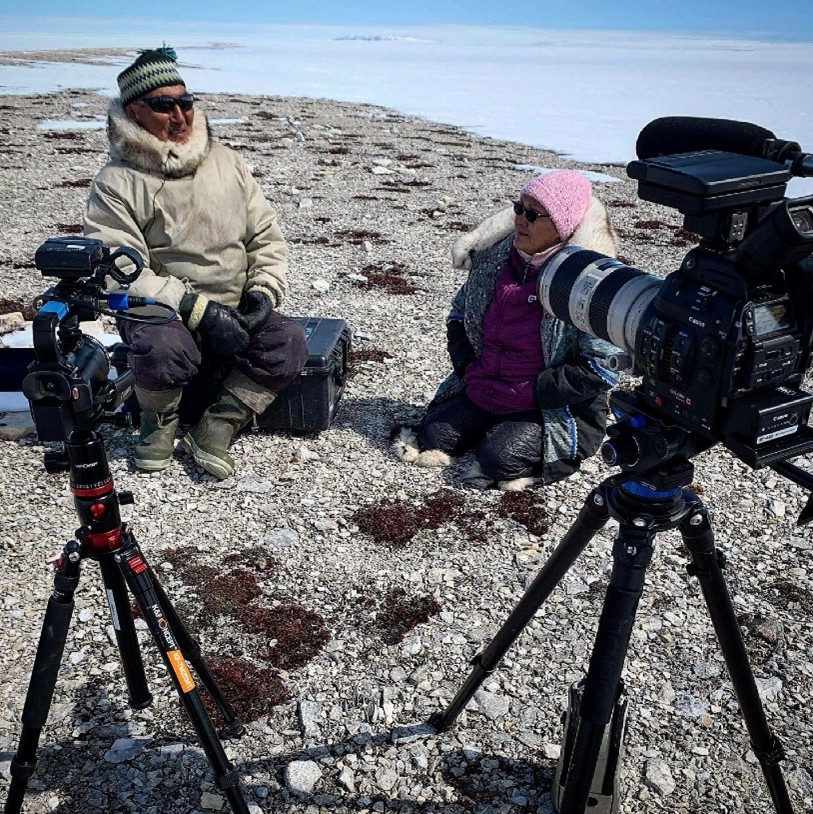
In partnership with the Nattilik Heritage Centre in Nunavut, and Parks Canada, Know History supported a multi-year oral history initiative centred on Inuit knowledge of the 1845 Franklin expedition and shipwrecks. Archival research was considered alongside Inuit oral traditions and lived experience.
Our team worked with Elders and knowledge holders to document interviews, contextualize historical materials, and grounded in Inuit Qaujimajatuqangit. The project demonstrates how preserved material can be interpreted through Indigenous knowledge systems and shared in forms that strengthen cultural continuity.
Cultural Resource Inventory and Interpretive Materials – Nunavut Tunngavik Inc.
Know History is leading a multi-year cultural resource inventory and interpretive materials project with Nunavut Tunngavik Inc. This work brings together archival research, digitized records, community engagement, and site documentation across multiple regions of Nunavut. Historical sources are analyzed alongside local knowledge to identify culturally significant places and stories.
From this foundation, we are developing interpretive frameworks and materials that support education, stewardship, and long-term heritage planning. The archive becomes a structured resource that supports both public understanding and long-term decision making.
From Record to Understanding
Digital archives preserve what happened. Interpretation helps people understand why it matters.
Historical records on their own do not automatically create clarity. They document events, decisions, voices, and moments in time. Without context, however, those materials can remain fragmented or inaccessible to broader audiences. Interpretation brings coherence. It situates records within social, political, and cultural frameworks. It asks careful questions about perspective, authorship, and meaning.
For Indigenous communities and cultural institutions in particular, this work carries additional responsibility. Archival records often reflect partial or externally produced narratives. Thoughtful interpretation creates space to integrate community knowledge, oral history, and lived experience alongside documentary evidence. It ensures that history is not only preserved but understood in ways that align with community priorities.
Know History works with organizations to bridge that gap between record and understanding. We help clients move from collection to context, and from documentation to public knowledge. The result is historical work that is rigorous, collaborative, and built to inform audiences with clarity and purpose.
Ready to transform your collection with digitization and interpretation? If you connect with Anderson Archival or Know History, we’ll ensure your vision is realized.