

Case Study: Unlocking Handwriting
CASE STUDY
Learn How We Use AI-Powered Solutions to Make Handwriting Accessible
Digitization Meets Access
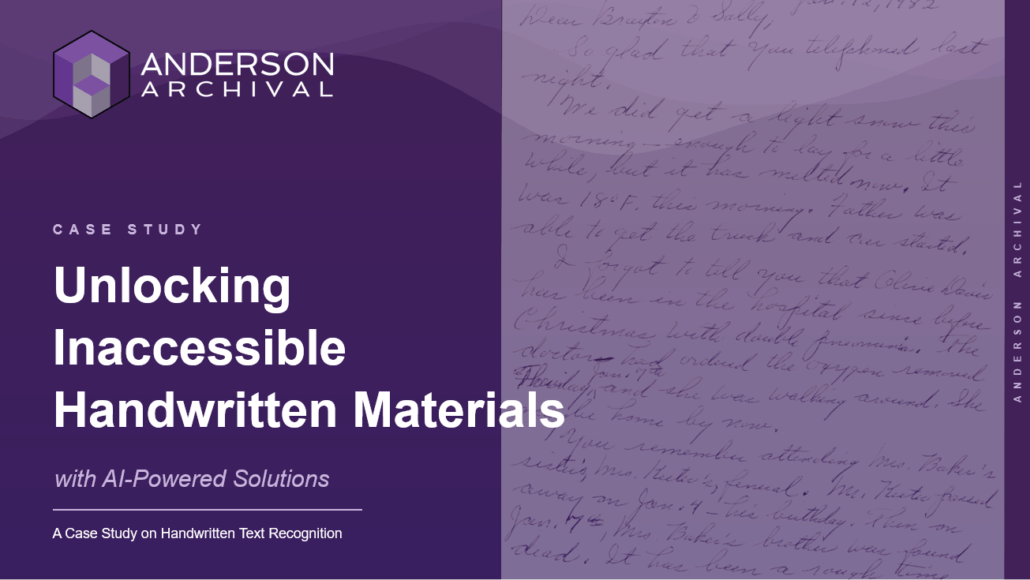
Here’s a quick case study on how the Anderson Archival team used AI-powered handwritten text recognition to make complex cursive documents searchable, easier to read, and more accessible for more people.
Need plain text? Keep reading below.
Subscribe to Our Newsletter
Digital preservation is about connecting to history. We do our best to bring you the important news and personal stories you’re interested in. We’re always looking for article ideas. Come learn with us!
Unlocking Inaccessible Handwritten Materials with AI-Powered Solutions
Scanned images preserve the page, but they don’t necessarily make the content readable, searchable, or usable for the people who need it most.
This case study describes how the Anderson Archival team used AI-powered handwritten text recognition (HTR) to turn complex cursive and varied handwriting styles into text that could be searched, exported, enlarged, and read with assistive technologies—without changing the original visual record.
Challenge: Handwriting as an Access Barrier
Handwritten materials can be some of the most valuable records in a collection, but they are also among the hardest to use. Researchers may need to skim thousands of pages to find a single name or event. Families may inherit boxes of letters they can’t easily read. And institutions that publish digital collections may discover that “available online” does not automatically mean “accessible.”
Cursive compounds the problem. Many users—especially younger generations—have limited experience reading historical handwriting styles, inconsistent spelling, or fading ink. Even when a person can read a page, the process is slow and error-prone.
Traditional digitization approaches help preserve and display images, but they typically fall short on handwritten text. Standard OCR performs well on clean, typed print, yet it struggles with cursive, variable letterforms, and unusual layouts. Manual transcription can work, but time and budget constraints make it difficult to apply consistently across large collections.
Approach: AI-Powered Handwritten Text Recognition
The team implemented an AI-based HTR workflow designed for real-world archival handwriting—where penmanship varies, pages may be skewed, and ink can be faint. At a high level, the process pairs high-quality scanning with machine learning models trained to recognize handwritten characters and convert them into structured text. The output can be indexed for search, reviewed for confidence, and delivered in formats that support downstream use cases.
Rather than replacing the original image, HTR adds a usable text layer, making handwritten pages searchable by keyword, enabling copy/paste for citation, and supporting larger print or screen readers. That shift—from “image-only” to “image + text”—is what turns digitized handwriting into a practical digital asset.
Project Examples (Anonymized)
Letters supporting a book project: In one engagement, a client needed a large set of personal letters transcribed so passages could be referenced within a narrative and searched by concept (themes, places, and recurring topics). HTR accelerated initial text capture, allowing human reviewers to focus on verification and editorial decisions rather than starting from scratch.
Historical correspondence for broad audiences: In another project, handwritten documents were made easier to consume by producing readable text versions that could be displayed with adjustable font sizes and used with assistive technology. This helped remove barriers for users with low vision and supported readers who struggle with cursive.
Confidential collections with consistent goals: Across additional private engagements, the pattern was the same: pair careful digitization with HTR to increase usability while maintaining appropriate handling of sensitive material. The result was faster discovery, less reliance on specialized readers, and a clearer path from preservation to access.
Impact and Outcomes
By adding an accurate text layer to handwritten scans, the organization expanded access for researchers, families, and the public. Users could locate names and events quickly, institutions could publish more usable digital collections, and teams could create alternative formats that better support diverse reading needs. Just as importantly, improved discoverability made it easier to preserve and pass on personal journeys and historical experiences—without requiring every reader to be fluent in cursive.
AI-powered handwritten text recognition helps archival teams move beyond preservation-only digitization toward true access. When combined with quality imaging and thoughtful review, HTR can unlock collections that were previously searchable only by manual reading—turning handwriting into text that can be found, read, and reused across formats.
Looking ahead, continued model improvements and clearer governance for sensitive collections will broaden what’s possible—supporting larger archives, more handwriting styles, and new ways to connect people with the primary sources that shaped their communities and families.