
By Client Executive Marica Spicer
It was an honor to kick off the Missouri Association of Museums and Archives’ 2026 Virtual Conference alongside the National World War I Museum & Memorial to highlight our work together. This year’s theme — “America 250: Hidden Histories, Unfinished Revolutions, and the Untold Narratives That Made a Nation” — set the stage for thoughtful conversations about what historical records reveal, what they leave out, and who gets represented.
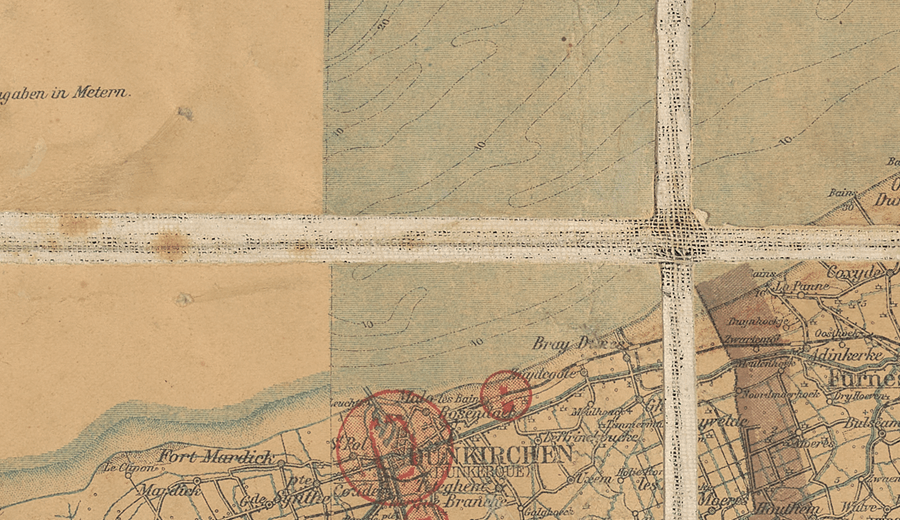
Our opening presentation explored a recent project digitizing the Museum’s oversized World War I maps in a continuation of our work on their newspapers and posters. These materials presented what I think of as the “big four” challenges: they were unwieldy, oversized, fragile, and complicated by fasteners, backings, or mountings.
Meeting those challenges required teamwork. Multiple team members carefully supported and positioned each map while it was photographed in overlapping sections. AI-assisted stitching helped assemble those sections into a complete digital image, and staff reviewed the results for alignment, accuracy, and completeness. We’ll share more about that process in a future blog, as it is a fascinating one.
The completed images are already supporting research and will lay the foundation for more thorough cataloging. Future users will be able to examine the maps without repeatedly handling the fragile originals. In this way, digitization supports both access and preservation, but closer access can also raise new questions.
Inspired by the conference theme, Digitization Specialist Marie Cayce investigated a subgroup of maps the Museum team has come to call the “racist maps.” A few contain French place names designated with racial slurs. Marie wanted to understand why.
The maps were often produced quickly by British mapmakers describing places in France they may never have visited. Each and every copse and tunnel needed to be identified and named, sometimes arbitrarily. Marie was unable to find a definitive explanation for the racist names, but that uncertainty was revealing in itself. A surviving record is not necessarily a complete or neutral one; it reflects the knowledge, assumptions, and viewpoint of the people who created it.
That idea echoed through Faye Dant’s presentation, “The Nation’s First Black Female Voters, Hannibal Aug. 31, 1920.” This history was entirely new to me. Dant shared how sixteen Black women cast ballots in Hannibal’s First Ward despite racial barriers and safety concerns. Their story adds important context to the familiar account of Marie Byrum, who became the first woman to vote in Missouri and possibly the nation following ratification of the 19th Amendment.
Marie drew a powerful connection between these subjects. Policies and practices—from redlining, to failing to capture the death records of soldiers of color, to failing to annotate important datum like race—can structurally hide people and their experiences. At the same time, the stories that are recorded often represent only a particular side.
That was my lasting takeaway from the conference: preserving a record is essential, but so is asking who created it, whose story it tells, and who may be missing. Through careful digitization, fuller cataloging, open research, and collaboration, we can protect historical materials while making space for better questions and a more complete understanding of the past.