

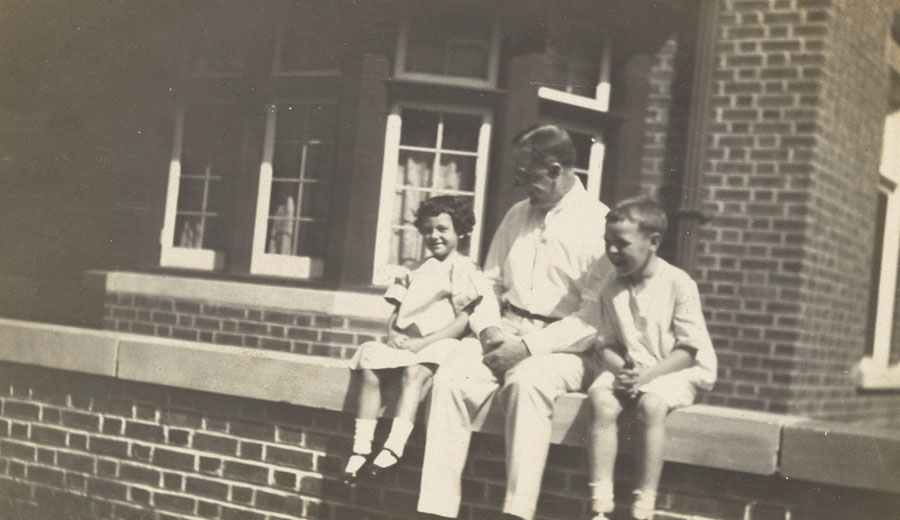
“My whole life I’ve been connected to this. So to now have it where it’s, wow, like I’d always dreamed it could be, is a gift. It’s just a gift.”
Thad Partridge
Family Collection
By Client Executive Marcia Spicer
Thad Partridge shares his experience with Anderson Archival
and a multi-phase project that digitized, cataloged, and organized his collection
When the collection came back, he already knew what he had sent us. He knew the trunk, the photographs, the letters, the albums, the pieces of family history that had accumulated around him over the years. What he hadn’t known was what all of that could look like when someone finally brought order to it.
Instead of the jumble he had been carrying, the collection came back intentionally arranged and professionally presented. Materials that had arrived in different shapes, sizes, containers, and conditions now looked as though they belonged together. There was a logic to it. A permanence. Nothing about the family history itself had changed, but the experience of holding it had.
And Thad noticed the difference immediately.
His sister may have put it best:
“It looks so calm now.”
For Thad, that calm represented more than organization. Years earlier, his father had left him with a simple responsibility: “You gotta keep this stuff together.”
Now, looking at what the collection had become, he could see that he had.
And in some ways, the result went beyond what he had known to ask for. He had set out to do right by the materials his family had entrusted to him. What came back was a collection that felt deliberate, cared for, and worthy of the history inside it.
Thad’s words have been lightly edited for clarity, length, and flow while preserving his voice and the substance of his recollections.
He Grew Up Inside the History
To understand why that mattered, you have to go back well before the trunk arrived in Thad’s home.
“I was born into kind of a crazy family,” he says. “I mean, everybody is, right?” Then he begins laying out a story that stretches through handwritten genealogies, photographs, telegrams, letters, diaries, houses, and generations of familiar objects.
On one side was what the family called the Brown Book, passed down and added to generation after generation—“We don’t have to do a DNA test because we literally have the writing of where everybody’s from”. On the other was a history that, in Thad’s telling, reached Connecticut in 1638 before moving west.
One of the most vivid chapters belonged to his great-grandfather, banker Arthur Reynolds. Outside records confirm the scale of the world Thad describes: Reynolds helped grow Continental & Commercial into the nation’s third-largest commercial bank by 1929. In Lake Forest, Illinois, he commissioned an estate completed in 1925, built around paneling, ceilings, and other interiors imported from Whitehall in Shrewsbury, England.
The papers preserve the social texture around that life: telegrams sent from the Biltmore in New York, instructions that a car would meet someone at the station, and an address book filled with names from the era’s industrial and financial circles. Thad tells the details with curiosity and a little disbelief, not reverence.
That paper trail also ran into the Great Depression. The crash changed the family’s circumstances and left consequences more serious than money. “It’s amazing to think how close we are to what seems like so far away,” Thad says. “It’s really only a couple of generations away.”
He understood early that the things around him were not simply old. They were records of how a family had moved through larger changes in American life.

The Jumble Kept Growing
The collection did not arrive all at once. It accumulated through the ordinary transfers and rescues by which family history so often survives.
After his parents divorced, his mother kept many of the records. Years later, she brought Thad a large trunk filled mostly with photographs, telegrams, and other papers. Meanwhile, he became the person who moved his father from house to house. When he found family papers under a staircase or somewhere they might be lost, he took them.
“One of the last things my dad said to me was, ‘Thad, you gotta keep this stuff together.’”
He did. When his mother’s house was cleared, still more appeared, including a box of letters dating to the early 1900s. “Stuff was just coming out of the walls,” he remembers.
He had grown up knowing the collection’s value. The problem was the widening distance between its importance and the way it had to be kept: photographs, albums, frames, tied bundles of letters, boxes, and the trunk, all occupying space in a life without a sprawling family house.
“We are now 70,” he remembers thinking. “We can’t keep hauling this around… What are we going to do with this stuff?… This needs to be preserved and digitized.”
This was the decision point: keeping the collection together now meant finding people who could carry out work within their expertise, work beyond what Thad could do alone.


Finding Someone Who Understood Why It Mattered
Thad began the way most people would: searching online for an archivist and a digital archivist. He started in California. Instead, his search led him to Anderson Archival in St. Louis.
“My God,” he remembers thinking. “I think this will work.” He sent an email saying he believed he had found the right people.
That confidence did not come from knowing every archival decision in advance. “I’m a good, fast decision-maker,” he jokes, “but I don’t always know what I’m deciding.” It came from being heard. Anderson assured him that his ideas could become a workable plan; when storage choices arose, he was shown options and remained part of the decisions.
Then came the handoff: from his San Francisco showroom, the materials went to a Los Angeles partner, were secured on a pallet, shrink-wrapped, and sent by common carrier to St. Louis. It was a considerable act of trust.
“Here we are just sending everything off to this place I just found online,” he says. The experience kept confirming his instinct. Having people who understood “what these things mean to people” and knew how to approach them made the work both capable and personal. “Obviously, my trust was very well placed.”


Order Emerges From the Jumble
The first task was to understand what had arrived: the family branches, material formats and conditions, and relationships among items separated by years of accumulation.
From there, photographs, letters, scrapbooks, and other materials were organized, prepared, and preserved; storage choices were made with Thad; and the physical archive was paired with a digitized collection. Each item could belong to a whole without losing the human traces that made it meaningful.
“Stacks of letters that were tied lovingly with ribbon” may carry affection, but can be difficult to approach. Once unfolded, ordered, protected, and labeled by family and date, the letters offered a place to begin. One box now moves through Reynolds family correspondence in date order. The “overwhelming amalgam” became legible without becoming impersonal.
Digitization mattered just as much. This “amazing feat” opened the archive without requiring the family to handle every original, and access made discovery possible.


“It Looks So Calm Now”
Two days before the interview, Thad finally moved the large shipping box from his showroom floor. He cleared a shelf in his office and began taking out the finished archival boxes.
“My mind was blown away,” he says. “This is priceless, what you guys have done for us. You’ve taken this overwhelming amalgam of our family history that’s in bits and pieces and different boxes and albums and picture frames—and put it into something that is so gorgeous in its simplicity.”
He showed one of the boxes to his sister, Vicky. Her response—“It looks so calm now”—named what he was seeing. The collection no longer arrived as a demand. It invited attention.
Thad opened a box of Reynolds family letters and read the labels aloud: February to May 1902, June to July 1902, August… Inside were the “gorgeous letters,” in order and ready to be read. “It is the most gorgeous thing I could ever see,” he said. “I am so absolutely thrilled with how this turned out.”
The beauty made the care visible. He had not simply retained the papers; he had carried out his father’s instruction: keep this stuff together. The result was more thoughtful than he knew to request and better than he had imagined, displaying “triumphs and tragedies” of the many family branches. This was more than relief that a project was finished. It was relief at seeing he had done right by his family.

Left: Arthur with daughter Jeanette (Thad’s grandmother) and son, Arthur Jr.
Right: Back of the photo, dated August 18, 1912

What Access Gave Back
Then came the discoveries.
In the digital files, Thad found photographs tucked inside letters—informal images the family had never seen. Instead of another formal studio portrait or life-size oil painting, there was his grandfather Arthur with his grandmother and uncle in a Santa Monica swimming pool.
“That was much more personal,” he says. “We never had seen that side of them before.”
A letter gave him something different, too: a beginning. Thad had long thought the collection would make an incredible book—“This is a miniseries,” he jokes—but could never work out how to start it. In the digital files, a friend’s condolence note recalled Grandma Dolly standing in the doorway as the writer drove away and reflected on a household about to be dispersed. “Soon the halls of Chiltern will have footsteps from strangers.” Thad had found his opening.
The photographs made hidden moments visible. The letter made a new project possible. Both were dividends of access, not the reason the preservation mattered in the first place.


A Gift, and a Decision
Thad is 72 now, and he speaks plainly about the choice facing people who hold family materials.
“We’re at a time in life right now where the people who are holding these materials need to decide what they’re going to do with them.”
“I grew up with an emotional connection to it,” he says. “My whole life I’ve been connected to this. So to now have it where it’s—wow—like I’d always dreamed it could be, is a gift. It’s just a gift.”
In his experience lies a message for other family keepers: when the materials matter, it also matters who does the work. “To have people who understand what these things mean to people, and also know how to approach things.”
Thad knew the family story. He knew the objects and the people inside them. What he needed was someone who knew how to transform that knowledge and responsibility into a finished collection.
“I believed you,” he says. “And you did it.”
